
How Weather Affects Rugby League Betting: Rain, Wind and Ground Conditions
 Available in US
Every punter checks the team sheets before placing a bet. Very few check the weather forecast. That oversight costs money, because weather is one of the most reliable and underpriced factors in rugby league betting. Rain, wind, heat, and ground conditions directly influence scoring patterns, error rates, and kicking accuracy — all of which feed into the markets that bookmakers set and bettors wager on.
The reason weather remains underpriced is partly structural. Bookmaker odds are typically set 48-72 hours before kick-off, when weather forecasts are still approximate. By game day, conditions may have changed significantly, but the lines have already been shaped by early betting volume and may not fully adjust. For the bettor willing to monitor the Bureau of Meteorology or the Met Office in the final hours before kick-off, this lag creates a window of genuine value.
This is not about predicting the weather perfectly. It is about understanding how different conditions change the way rugby league games play out, and adjusting your betting approach accordingly.
When It Rains, the Under Wins
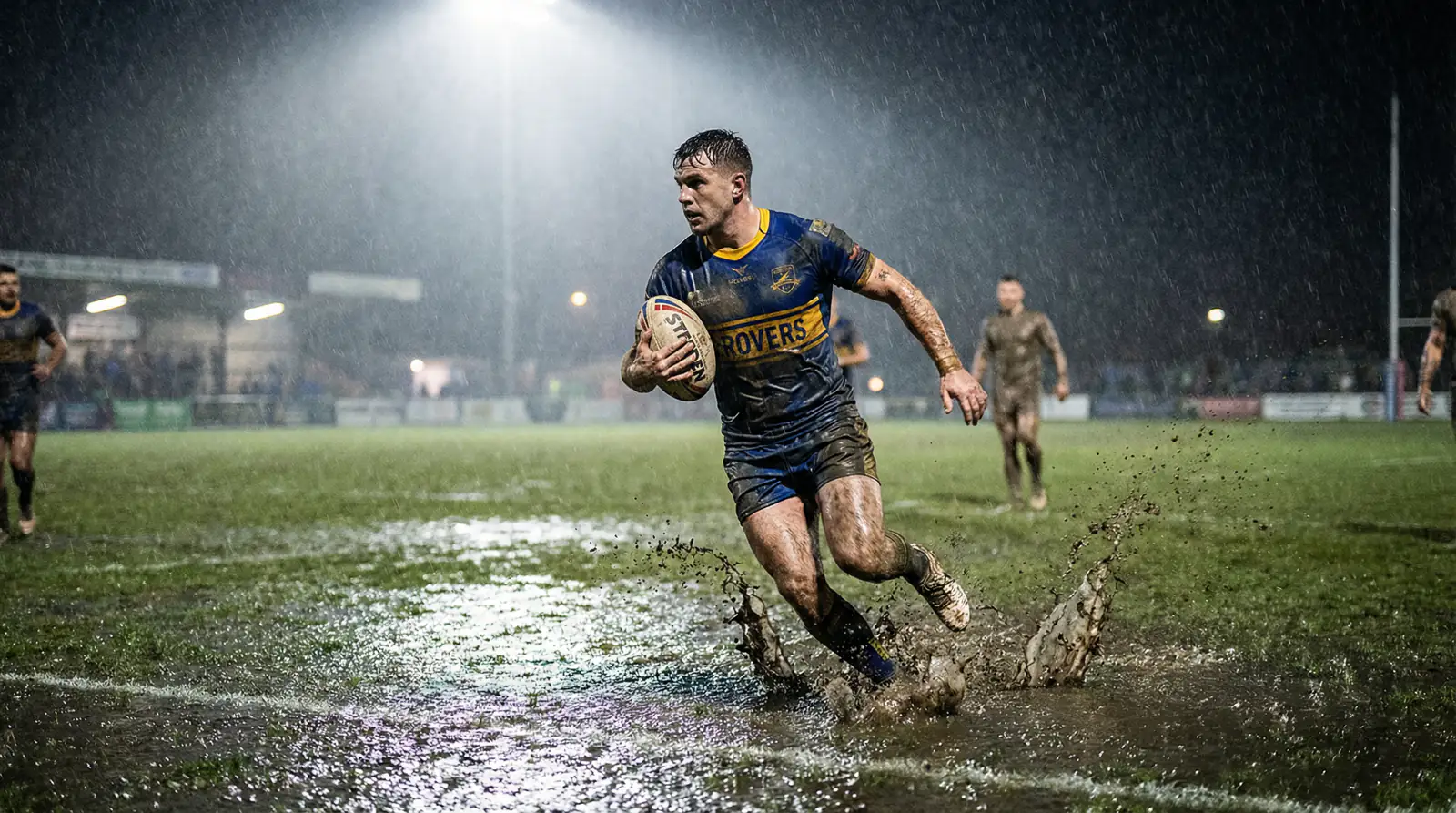
Rain is the single most impactful weather variable in rugby league betting. Wet conditions affect every phase of the game: handling errors increase, kick returns become more dangerous, and attacking plays that rely on offloads and quick passing break down more frequently. The result is a predictable shift toward lower-scoring, tighter contests.
The data is consistent across both NRL and Super League. Games played in heavy rain produce, on average, 8-12 fewer points than games played in dry conditions. That gap is substantial when you consider that the bookmaker’s over/under line is typically set within 2-3 points of the expected total. A line set at 42.5 based on dry-weather assumptions becomes an obvious under play when the forecast calls for persistent rain throughout the match.
Beyond the total points market, rain affects try-scoring patterns in ways that create value in player markets. Forwards — particularly front-rowers and lock forwards who carry the ball in heavy traffic close to the tryline — become more prominent try-scoring threats in wet weather because teams rely on crash plays rather than wide passing movements. The opposite applies to outside backs: wingers and centres who score most of their tries from set-piece plays and width see their try-scoring probability drop noticeably in the wet.
Rain also compresses the handicap market. Blowouts are significantly less common in wet conditions because the inferior team’s defensive effort is supplemented by the conditions — the better team simply cannot execute the plays that would normally allow them to pile on points. If you see a handicap line of -12.5 for the favourite and heavy rain is forecast, the underdog plus the points becomes a structurally sound bet.
The Wind Factor Most Bettors Ignore
Wind is the quieter weather variable, but in certain conditions it is just as significant as rain. Strong crosswinds or headwinds affect goal-kicking accuracy, bomb kicks, and long-range field goals — all of which have direct implications for scoring and market pricing.
Goal-kicking is the most obvious impact. A kicker with an 80% conversion rate in still conditions will drop to 60-65% in a strong crosswind, and that percentage falls further for attempts from the touchline. In a game where three or four conversion attempts are affected, the lost points from missed kicks can easily swing the total under the bookmaker’s line. Penalty goal attempts from beyond 35 metres become low-probability propositions in gusting conditions, which matters for the “next scoring method” market in live betting.
Wind direction relative to each half matters too. Teams kicking with a strong tail wind in the first half often build early leads through field position dominance and longer kicks that pin the opposition deep. The second-half reversal then sees the trailing team gain the same advantage. This creates a predictable pattern for half-time/full-time betting: the team with the wind in the first half is more likely to lead at the break, but the full-time result is harder to predict because the second-half wind advantage shifts the balance.
Ground-level conditions at open stadiums are not always the same as the forecast wind speed suggests. Enclosed or partially enclosed venues like rectangular stadiums with high stands can create swirling conditions that are worse than the headline wind speed implies, while open suburban grounds can see wind channelled in unpredictable directions. Knowing the specific venue characteristics matters as much as reading the weather report.
See also home ground advantage.
Heat and Humidity: The Invisible Game Changer
Temperature rarely makes the betting headlines, but extreme heat — particularly the 35-degree-plus days that hit the early NRL rounds in February and March — has a measurable effect on game outcomes. Heat exhausts players faster, reduces the intensity of defensive efforts in the middle period of each half, and increases the likelihood of fatigue-related errors in the final twenty minutes.
The scoring impact of extreme heat is the opposite of rain. Hot-weather games tend to produce higher totals because defensive structures degrade as the match progresses. Tired forwards miss tackles, the defensive line loses its shape, and teams that are behind on the scoreboard find it physically impossible to sustain the effort required to complete a comeback. The result is often a game where the first-half margin is modest but the second half opens up as one team physically wilts.
For NRL bettors, the early-season rounds played in the Australian summer heat are prime territory for over bets on total points, particularly in games involving teams with shallow rosters or limited bench depth. Teams that rotate their middle forwards effectively and have genuine depth in their squad handle heat better than teams reliant on a small group of high-minute players. Checking the interchange usage patterns from recent games is a practical way to identify which teams are most vulnerable to heat-related performance drops.
Humidity adds another layer. Games played in tropical venues like Townsville or in South-East Queensland during the wet season combine heat with oppressive moisture that saps energy even faster than dry heat. These conditions disproportionately affect visiting teams from southern states who are not acclimatised, creating a measurable away-team disadvantage beyond the usual home-ground effect.
Ground Conditions and Surface Type
The playing surface itself is a variable that most bettors overlook entirely. NRL and Super League games are played on a range of surfaces — from pristine purpose-built rectangular stadiums to multi-use venues that host cricket, AFL, or soccer on the same turf during the week. The quality of the surface directly affects the style of play that is possible.
A hard, fast surface in dry conditions favours running rugby. Ball carriers gain more metres after contact because their footing is secure, and defensive players find it harder to plant and change direction. These conditions produce more line breaks, more offloads, and generally higher scoring. A heavy, churned-up surface — common at the tail end of winter in Super League or at shared NRL venues after a week of rain — slows the game down, reduces the effectiveness of footwork-reliant players, and puts a premium on forward-dominated, grinding football.
Surface conditions interact with team styles in predictable ways. A team built around a dominant forward pack and a kicking-game halfback will perform closer to their best on a heavy surface than a team that relies on speed, width, and backline creativity. When the ground is heavy, the advantage shifts toward the physically bigger, less mobile team — and the betting market does not always reflect this because bookmakers price games based on overall season form rather than condition-specific form.
The practical step for bettors is simple. Before placing any bet on an NRL or Super League match, check the weather forecast for the venue, look at whether the ground has been used for other events that week, and consider how the conditions match up with each team’s playing style. This takes five minutes and gives you information that the majority of the betting public is ignoring.
Your Pre-Bet Weather Checklist
Rather than treating weather as an afterthought, build it into your standard pre-bet process. The information is free, publicly available, and takes minimal time to gather — but it can fundamentally change whether a bet represents value or not.
Before placing any rugby league bet, check the following: the rainfall forecast for game time, not just the day — a morning shower that clears by kick-off is irrelevant, while light persistent rain throughout the match changes everything. Check the wind speed and direction at the venue, particularly for afternoon games at open grounds. Check the temperature and humidity, especially for early-season NRL and mid-summer Super League rounds. Check whether the venue has hosted other events in the preceding days that might have degraded the surface. Weather impact betting on rugby league betting tips.
This is not complicated analysis. It is basic due diligence that separates bettors who take their process seriously from those who treat every match as if it is being played in a climate-controlled dome. The weather does not care about your pre-game analysis. But if your pre-game analysis cares about the weather, you are already ahead of most of the market.
