
Rugby League Betting Tips: The Complete Guide to Winning NRL and Super League Wagers
 Available in US
Rugby League Betting Tips Why Rugby League is Ideal for Sports Betting
Rugby league betting has evolved from a niche pastime into a sophisticated market attracting millions of punters worldwide. Whether you follow the bone-crunching collisions of the NRL in Australia or the gritty battles of the Super League in England,
the sport offers a compelling betting proposition that rewards those who do their homework. The 2026 season brings fresh storylines, emerging talents, and opportunities for bettors who understand how to read the game beyond what happens on
the field.
The appeal of rugby league betting lies in its relative predictability compared to other sports. Unlike football where a single deflected shot can decide a match, rugby league rewards consistent execution over 80 minutes. Teams that dominate possession,
complete their sets, and control field position tend to win. This structural logic creates patterns that sharp bettors can exploit, particularly when bookmakers misprice matches based on public perception rather than underlying form.
Yet rugby league betting is far from straightforward. The sport demands understanding of specific dynamics that do not translate from other codes. A halfback carrying a minor injury might still play but significantly reduce his team’s attacking
threat. Wet weather transforms attacking contests into defensive arm-wrestles with different scoring patterns. State of Origin duties strip NRL teams of their best players mid-season, creating value opportunities that casual punters overlook.
This guide provides a comprehensive framework for approaching rugby league betting with discipline and intelligence. We cover essential differences between rugby league and rugby union that directly impact betting markets, explain every major
market type from head-to-head to first try scorer, and share strategies that separate profitable punters from those who donate to bookmakers. Whether you focus on NRL, Super League, or international competitions, the principles here apply
across all levels of the sport.
The information presented reflects current market conditions and competition formats as of 2026. Remember that all forms of gambling carry risk, and no strategy guarantees profits. The goal here is education, helping you make more informed decisions
rather than relying on gut feelings or tipster hype. The following sections build upon each other, starting with fundamentals and progressing to advanced concepts.
Rugby League Betting Basics Every Punter Must Know
Rugby League vs Rugby Union: Key Differences for Bettors
Understanding the distinction between rugby league and rugby union is not merely academic trivia. These differences fundamentally shape betting markets, scoring patterns, and strategic considerations that directly impact your wagering decisions.
Confusing the two codes is like treating American football and Canadian football as identical. They share DNA but play quite differently.
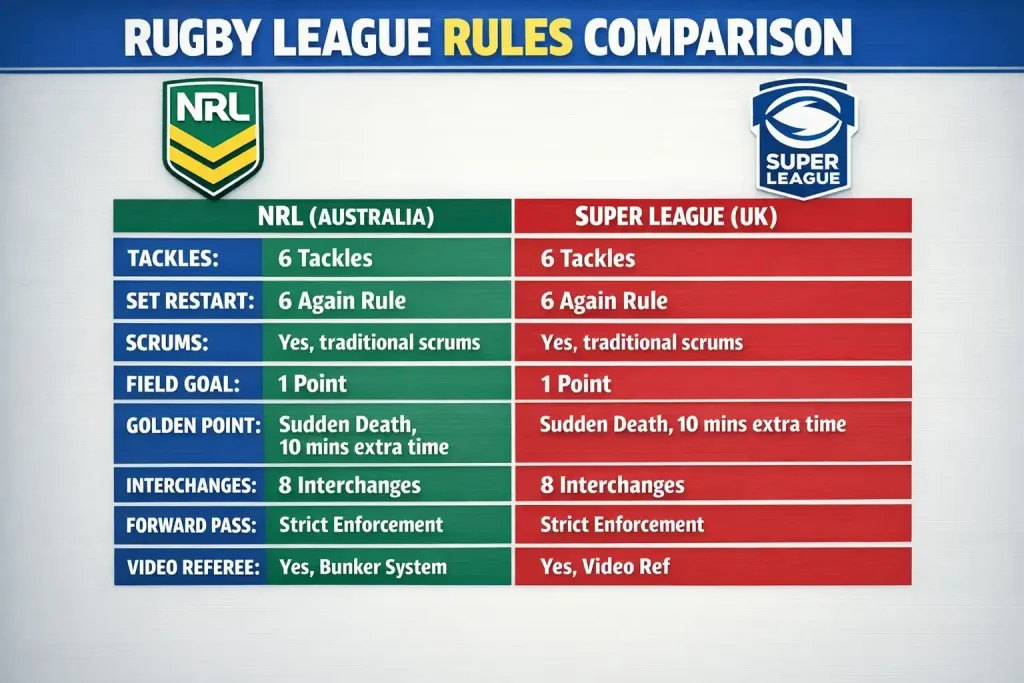
Rugby league features 13 players per side compared to union’s 15, creating more space on the field and typically higher-scoring contests. The six-tackle rule in league forces teams to hand over possession after six phases if they have not scored
or kicked, making the game more structured and predictable than union’s continuous possession battles. This structure creates rhythm in matches, allowing bettors to anticipate when attacking raids will occur and when teams will kick for territory.
The scoring system also diverges significantly. In rugby league, a try is worth four points rather than union’s five, while conversions remain at two points. Field goals contribute one point in league but three in union. These differences might
seem minor, but they shape late-game scenarios dramatically. A team trailing by five points in league needs more than a converted try to win, creating different strategic dynamics compared to union where that deficit is recoverable with a
single touchdown and conversion.
The pace of rugby league suits certain betting markets particularly well. Higher average scores mean totals markets have more room for variation, and the structured attack patterns create identifiable trends for try scorer betting. Union’s more
chaotic breakdowns and contested possession make similar predictions far less reliable.
Major Rugby League Competitions to Bet On
The NRL stands as the premier rugby league competition globally, featuring 17 teams across Australia and New Zealand competing from March through October. The competition attracts the world’s best players and offers the deepest betting markets,
with bookmakers pricing everything from match results to individual player performance metrics. The 27-round regular season provides consistent weekly betting opportunities, while the finals series generates intense interest and significant
betting volume.
Super League represents the pinnacle of Northern Hemisphere rugby league, with 14 teams based primarily in England and France competing from February to October. The competition has grown significantly in betting popularity, though markets remain
shallower than NRL equivalents. Super League’s playoff system differs from the NRL, with the top six teams qualifying for the finals series that culminates in the Grand Final at Old Trafford.
Beyond these domestic competitions, several international and representative fixtures deserve attention. The State of Origin series between New South Wales and Queensland represents the highest standard of rugby league, with three brutally intense
matches annually that generate enormous betting interest. The Challenge Cup in England provides knockout football with potential for upsets, while the Rugby League World Cup occurs every four years, pitting national teams against each other
in tournament format.
Understanding the calendar matters for betting purposes. NRL teams lose their Origin representatives mid-season, creating form fluctuations that sharp bettors exploit. Super League navigates the Challenge Cup alongside league fixtures, leading
to squad rotation that impacts results. These competition-specific factors often catch casual punters off guard while creating value for those paying attention.
Complete Guide to Rugby League Betting Markets
Head-to-Head (Moneyline) Betting
The simplest form of rugby league betting asks you to pick the match winner. Head-to-head markets eliminate complexity, requiring only correct identification of which team will be ahead after 80 minutes. Draws are possible though rare in rugby
league, and most bookmakers offer three-way markets that include the tie option at longer odds.
Value in head-to-head markets often emerges when public perception diverges from underlying form. A team coming off two consecutive losses might drift in the betting despite both defeats being narrow away fixtures against top-four opposition.
Conversely, a mid-table team that thrashed a cellar-dweller at home might shorten beyond their true probability because casual punters overweight recent results.
Timing matters significantly in head-to-head markets. Early-week prices often differ substantially from kick-off odds as team news emerges and sharp money influences the market. Injured playmakers affect teams disproportionately in rugby league
since so much attack flows through the halfback and fullback positions. Monitoring team announcements reveals opportunities that disappear by game day.
Handicap (Line) Betting
Handicap betting levels the playing field by giving one team a virtual head start. If Brisbane Broncos face a struggling Gold Coast Titans side, the head-to-head odds might be prohibitively short on Brisbane. Instead, bookmakers offer Brisbane
at minus 12.5 points, meaning they must win by 13 or more for your bet to succeed. Alternatively, backing Gold Coast plus 12.5 means they can lose by up to 12 points and your bet still wins.
Understanding key numbers in rugby league handicaps separates competent punters from amateurs. Converted tries account for six points, meaning margins of 6, 12, 18, and 24 occur more frequently than surrounding numbers. A handicap of minus 11.5
versus minus 12.5 might seem similar, but that extra point crosses a key number threshold with significantly different cover rates.
Line betting rewards those who assess scoring potential rather than simply picking winners. A defensive outfit might win most games but rarely cover large spreads because they grind out low-scoring victories. Conversely, attacking teams often
exceed expectations when they win, covering spreads despite inconsistent head-to-head records.
Over/Under (Totals) Betting
Totals markets ask whether combined match scoring will exceed or fall short of a bookmaker-set line. A typical NRL game might be priced at 42.5 total points, requiring you to predict whether teams will combine for 43 or more (over) or 42 or fewer
(under). The half-point eliminates ties, forcing a decisive outcome.
Weather conditions influence totals more than any other factor in rugby league. Rain makes handling difficult, increasing errors and reducing scoring efficiency. Wind affects kicking accuracy, while extreme heat leads to fatigue and sloppy play.
Checking forecasts before betting totals provides edge over punters who ignore environmental factors.
Team matchups create totals opportunities beyond weather considerations. When two defensively sound teams meet, unders become attractive regardless of conditions. Attacking powerhouses trading points pushes matches toward overs. Identifying when
bookmakers have priced totals based on team averages rather than specific matchup dynamics reveals value that season-long statistics obscure.
First Try Scorer Betting
First try scorer markets combine skill and luck in roughly equal measure, making them popular among recreational punters seeking longer odds payouts. Wingers and fullbacks score the most tries in rugby league due to their positioning on the attacking
edge, but they also carry the shortest prices, limiting value potential.
Finding value in try scorer markets often means identifying overlooked candidates. Edge forwards occasionally crash over from short range, and centers benefit from defensive misalignments that create space. Hookers running from dummy half catch
defenses napping, particularly early in matches when fatigue has not yet set in. These positions typically offer better odds-to-probability ratios than the obvious winger selections.
Team news critically impacts try scorer betting. Late scratchings can promote players into positions with greater try-scoring opportunity, while tactical shifts might see a winger moved to fullback where he sweeps across in support of line breaks.
Waiting for confirmed team lists before betting try scorer markets protects against selecting players who end up starting from the bench or missing entirely.
Winning Margin Betting
Margin betting extends handicap concepts by asking punters to predict victory bands rather than covering a specific line. A team might be priced at different odds to win by 1-6 points, 7-12 points, 13-18 points, or 19+ points. This market rewards
precise game assessment but carries higher risk since multiple scenarios lose your stake.
The appeal lies in enhanced odds compared to simple handicap betting. If you believe a team will win comfortably, backing them at the 13-18 margin might pay three or four times what minus 12.5 handicap offers. However, this precision comes at
cost since outcomes just outside your selected band convert winning assessments into losing bets.
Margin betting suits situations where you hold strong conviction about match dynamics. A fast-starting team facing slow starters often races to large leads before the game settles, potentially reaching margins that early odds underestimate. Similarly,
dominant defensive teams often control matches without blowing out opponents, making narrow to moderate margins attractive selections.
Half-Time/Full-Time Betting
This market combines predictions about which team leads at half-time and which team wins the match. Nine possible outcomes exist, from home leading at both intervals to away completing a comeback after trailing at the break. Odds vary dramatically
based on combination probability, with dominant team scenarios priced short and comeback selections offering substantial returns.
Identifying comeback candidates requires understanding team second-half patterns. Some coaches make exceptional half-time adjustments, transforming sluggish first-half performances into dominant closing periods. Other teams fade physically as
matches progress, surrendering leads they established early. Historical second-half performance data reveals these tendencies and highlights value in specific scenarios.
Weather changes during matches occasionally create half-time/full-time opportunities. Afternoon games might begin in sunshine and finish under clouds, affecting visibility and kicking accuracy. Such transitions particularly impact teams heavily
reliant on structured kicking games versus those preferring to run the ball regardless of conditions.
Futures and Outright Betting
Season-long markets let you bet on premiership winners, minor premierships, top try scorers, and other season-long outcomes. These markets open before seasons commence and adjust throughout the year as team fortunes rise and fall. Early-season
value often exists before bookmakers have fully assessed squad changes and emerging form.
Premiership betting rewards those who look beyond obvious favorites. Every season produces surprise packages that outperform pre-season expectations, and identifying potential overachievers before odds shorten represents the purest form of betting
value. Conversely, backing proven champions at prohibitively short prices rarely generates acceptable returns for the risk involved.
Top try scorer markets reward patience and observation. Early-season favorites sometimes lose form or suffer injuries, while unheralded players emerge into prolific scoring runs. Monitoring these markets throughout the season identifies opportunities
as odds shift.

Proven Strategies for Profitable Rugby League Betting
Analyzing Team Form and Performance
Form analysis goes beyond checking recent results on a league table. A team might show a record of three wins and two losses from their last five matches, but deeper examination reveals crucial context that simple records obscure. Were those wins
against top-eight opposition or bottom-four strugglers? Did the losses come at home or away? How did point margins compare to expectations?
Weighting recent results appropriately requires considering opponent quality, venue, and circumstances. A narrow away loss to the competition leader might indicate better form than a comfortable home win against a depleted opponent. Creating your
own ratings system that accounts for these factors produces more accurate assessments than relying on media narratives or public perception.
Head-to-head records between specific teams often reveal psychological edges that persist beyond current season form. Some teams consistently perform above expectations against particular opponents due to favorable stylistic matchups or historical
rivalry motivation. Conversely, bogey teams inexplicably struggle against seemingly inferior opposition. These patterns rarely reflect in betting odds as strongly as recent form, creating opportunities for those who dig deeper.
The Impact of Weather Conditions
Weather transforms rugby league matches more than casual observers appreciate. Wet conditions increase handling errors, reduce line break frequency, and make kicking accuracy paramount. Teams with dominant kicking games and disciplined defensive
structures thrive in rain, while flair-based attacking outfits struggle to express their talents. Checking weather forecasts before finalizing any rugby league bet should be non-negotiable practice.
Wind affects matches differently depending on stadium configuration. Enclosed venues minimize wind impact, while open grounds expose players to gusts that turn routine kicks into adventures. Strong crosswinds trouble goal kickers, potentially
influencing point margins by several conversions over a match. Tailwinds benefit attacking kicks but make defensive positioning more challenging.
Temperature extremes also warrant consideration. Intense heat leads to fatigue that manifests in increased errors and slower recovery between plays. Night games in winter feature very different physical demands than afternoon fixtures in summer.
Teams with superior bench depth handle extreme conditions better, maintaining intensity while opponents visibly tire.
Home Advantage in Rugby League
Home advantage exists in rugby league, though its magnitude varies between competitions and individual teams. NRL teams playing at their home ground win approximately 55-58% of matches historically, providing baseline expectations against which
to measure specific situations. Super League home advantage appears slightly stronger, possibly due to greater travel distances between northern English venues.
Some teams possess significantly stronger home advantages than others. Regional clubs with passionate supporter bases create intimidating atmospheres that genuinely affect opposition performance. Teams that play on unique surfaces or in unusual
conditions also benefit from familiarity that visitors lack. Identifying which teams consistently outperform expectations at home versus away reveals profitable betting angles.
Interstate and international travel impacts NRL results measurably. Melbourne-based teams playing in Queensland face longer travel than Sydney derbies, and New Zealand-based clubs crossing the Tasman encounter time zone adjustments alongside flight
fatigue. Backing home teams against visitors who have traveled significantly sometimes reveals value that standard ratings miss.
Key Player Injuries and Team News
Individual player importance varies dramatically in rugby league. Losing a competent second-rower matters far less than losing an elite halfback who orchestrates every attacking movement. Fullbacks who sweep across the defensive line to create
overlaps similarly influence results disproportionately to their single roster spot. Assessing injury news through this lens of positional importance sharpens betting decisions.
Team announcements typically occur several days before matches, with final confirmations closer to kickoff. Sharp bettors monitor these announcements closely, identifying late changes that shift match dynamics. A star fullback listed to play might
be downgraded to the bench or ruled out entirely as kickoff approaches. Those who react quickly to such news often find value before bookmakers fully adjust their prices.
Beyond injuries, suspension and representative duty create selection absences that affect teams differently. Clubs with strong depth absorb losses better than those relying heavily on key performers. Identifying which teams maintain performance
despite absences versus those that collapse without their stars informs both match betting and handicap assessments.
Value Betting Approach
Value betting means identifying odds that exceed your assessment of true probability. If you calculate that a team has a 60% chance of winning but bookmakers offer odds implying only 50% probability, you have found value regardless of whether
that individual bet wins. Over time, consistently betting when you hold such edges produces profits despite inevitable short-term variance.
Developing your own ratings system creates the foundation for value identification. Whether you use statistical models, qualitative assessments, or some combination, having independent probability estimates lets you compare against market prices
objectively. Without such estimates, you simply guess which odds look attractive.
Line movement tracking reveals where sharp money flows. When opening odds drift significantly toward one team, professional bettors have likely identified value on the other side. Understanding these movements helps less experienced punters identify
opportunities they might otherwise miss.
NRL Betting Tips: Mastering Australia’s Premier Rugby League
Understanding NRL Season Structure
The NRL regular season spans 27 rounds, providing extensive opportunity to observe team patterns and identify reliable betting angles. Early-season results often mislead as teams integrate new signings and adjust to coaching changes. Form typically
stabilizes by round eight or nine, making mid-season assessments more reliable than opening-month conclusions.
Finals series betting differs substantially from regular season wagering. Only eight teams qualify, and elimination football pressure changes performance dynamics. Teams that cruise through the regular season sometimes falter when intensity rises,
while others elevate when stakes increase. Historical finals form provides better guidance than regular season records.
The grand final represents the season’s climactic match, attracting enormous betting volume and correspondingly sharp odds. Finding value proves difficult since market efficiency peaks for this fixture. Futures betting on grand final participants
before the season typically offers better value than waiting for final weeks.
Top NRL Teams to Watch
Premiership contenders declare themselves through consistent performance against quality opposition. Teams that dominate lower-ranked opponents but struggle against other top-eight sides often disappoint in finals when they face consecutive quality
matchups. Assessing performance specifically against other contenders reveals genuine championship credentials more accurately than overall win-loss records.
Mid-table teams frequently present the best betting value in NRL. Bookmakers and public alike focus attention on premiership races, potentially mispricing matches involving seventh or eighth place battles. These fixtures carry significant season
implications and feature motivated teams playing quality football, yet often receive less analytical attention than matches involving traditional powerhouses.
Identifying teams positioned to improve or decline from previous seasons rewards pre-season research. Coaching changes, key signings, and player departures all influence trajectory. A team that finished sixth might strengthen into a top-four contender,
while a club that barely missed finals could spiral downward if key departures create unfillable gaps.
NRL-Specific Betting Tips
Thursday night NRL matches display distinct patterns worth monitoring. These fixtures often feature teams with short turnarounds from previous weekend matches, creating fatigue factors absent from Sunday games with full recovery periods. Home
teams historically perform slightly better on Thursday nights, possibly due to reduced travel recovery time for visitors.
Sunday afternoon games present different considerations. Extended recovery from midweek training allows full squad availability, but afternoon heat during summer months tests physical conditioning. Teams with superior bench depth handle these
conditions better, maintaining intensity while opponents visibly fade in final quarters.
Interstate travel impacts NRL results in predictable ways. Victoria-based teams playing in Queensland face different challenges than teams making the reverse journey. New Zealand-based clubs deal with Tasman crossings that accumulate fatigue throughout
seasons. Factoring travel into match assessments, particularly for teams making multiple consecutive away trips, reveals value that surface-level analysis misses.
State of Origin Betting Guide
State of Origin represents rugby league’s highest standard, pitting New South Wales against Queensland in three matches that define Australian rugby league each season. The intensity far exceeds regular NRL matches, creating scoring patterns and
match dynamics that require separate analytical approaches. Simply extrapolating from NRL form to Origin predictions often misleads since the representative context transforms player performance.
Series betting lets you wager on which team wins the overall three-match contest rather than individual games. This market removes single-match variance since a team can lose one game yet still win the series. Historical patterns show that series
outcomes correlate less strongly with pre-series expectations than individual match results, suggesting bookmakers struggle to price series markets efficiently.
Player form in Origin context differs from club performance. Some players consistently elevate for representative duty while others shrink under the increased pressure and physicality. Identifying which players have strong Origin records versus
those who historically underperform in the arena provides edge when assessing team compositions and likely match outcomes.

Super League Betting Tips: Conquering UK Rugby League Markets
Super League Season Overview
Super League operates with 14 teams competing across 27 rounds before the top six enter playoff contention. This structure differs from NRL’s eight-team finals format, creating different late-season dynamics. Teams near the playoff bubble face
pressure earlier in the season, affecting form patterns and motivation levels that bettors can exploit.
The playoff system culminates in the Grand Final at Old Trafford, a venue traditionally favoring teams comfortable with the big occasion. Experience in high-stakes matches correlates with Grand Final performance more strongly than regular season
dominance. First-time finalists often struggle with occasion pressure regardless of their path to the final.
Magic Weekend concentrates multiple Super League matches at a single neutral venue, creating unusual betting dynamics. Home advantage disappears entirely, and unfamiliar pitch dimensions occasionally affect team performance. These fixtures deserve
separate analytical treatment rather than extrapolation from regular home and away patterns.
Top Super League Teams Analysis
Wigan Warriors have established recent dominance, combining financial resources with excellent coaching and player development. Their consistency makes them frequent short-priced favorites, limiting value opportunities in head-to-head markets
but creating potential in handicap betting where bookmakers sometimes overestimate winning margins against competent opposition.
St Helens maintain perennial contender status despite squad transitions, demonstrating organizational excellence that transcends individual player departures. Betting against them in big matches requires strong conviction since they consistently
deliver in high-pressure situations. Their historical Grand Final record particularly warrants respect when pricing playoff scenarios.
Hull KR have emerged as genuine title contenders, transforming from mid-table mediocrity into championship challengers through smart recruitment and tactical innovation. Their rise caught bookmakers slow to adjust prices early in recent seasons,
and similar lag might occur as other emerging teams develop. Identifying the next Hull KR before odds shorten represents high-value opportunity.
Super League-Specific Betting Angles
Friday night fixtures dominate the Super League calendar, creating consistent weekly rhythm for betting purposes. Teams generally have full recovery periods for these matches, minimizing fatigue factors that complicate NRL scheduling analysis.
Form assessment becomes more straightforward when most teams operate on similar preparation timelines.
Challenge Cup integration adds fixture congestion that affects league performance. Teams advancing deep into the cup face additional match loads that accumulate physical toll throughout the season. Monitoring cup runs and their impact on league
form reveals betting opportunities as fatigued squads face fresh opponents in league competition.
European climate creates unique considerations absent from NRL analysis. Winter matches in Northern England feature conditions rarely encountered in Australian rugby league, affecting playing styles and scoring patterns. Teams that embrace wet-weather
football outperform fair-weather opponents when conditions deteriorate, creating predictable edges for those who track such patterns.
European Climate Considerations
Winter weather genuinely transforms Super League matches in ways that NRL conditions rarely replicate. Freezing temperatures affect ball handling, strong winds make kicking hazardous, and waterlogged pitches slow play dramatically. Teams built
around forward dominance and structured kicking thrive in these conditions while those relying on expansive attacking play struggle to execute their game plans.
Fixture congestion during winter months compounds weather challenges. Teams playing twice weekly have limited recovery time, making squad depth more valuable than individual star quality. Clubs with strong academy systems producing capable backup
players maintain performance through congested periods while those relying on thin senior squads inevitably fade.
Spring improvement often sees previously struggling teams rally as conditions improve. Attacking sides suppressed by winter weather suddenly express their talents when dry pitches return. Identifying which teams’ true quality exceeds their winter
records reveals value as conditions improve but odds lag behind performance potential.
In-Play Rugby League Betting: Real-Time Wagering Strategies
How Live Betting Works in Rugby League
Live betting lets you place wagers during matches as odds fluctuate in response to on-field developments. Bookmakers adjust prices continuously, shortening teams that build leads and lengthening those falling behind. This creates opportunities
for bettors who can assess match dynamics more accurately than automated pricing algorithms.
Odds suspend during active play and reopen during breaks in action. Try-scoring attempts, video referee consultations, and injury stoppages all trigger suspensions. Sharp live bettors position themselves to act quickly when markets reopen, knowing
that optimal prices often exist only briefly before subsequent adjustments. Slow reaction times forfeit edge that faster bettors capture.
Cash-out options let you close positions before matches conclude, locking in profits or minimizing losses depending on how events unfold. This feature adds strategic flexibility but carries cost since bookmakers extract margin on cash-out prices.
Using cash-out judiciously when circumstances warrant beats either ignoring the feature entirely or reflexively closing positions at every opportunity.
Best In-Play Markets for Rugby League
Next try scorer markets offer frequent betting opportunities during matches, with odds adjusting based on field position, momentum, and player involvement. When a team camps near the opposition line, odds on their likely try scorers shorten dramatically.
Identifying value before odds fully adjust requires anticipating which attacking plays will develop and which players will be positioned to finish.
Match winner markets swing dramatically on momentum shifts. A team scoring consecutive tries sees their odds shorten rapidly, sometimes excessively relative to true probability changes. Backing teams that have just conceded when markets overreact
creates value for those who can distinguish between genuine momentum shifts and temporary fluctuations.
Live totals markets let you bet on whether remaining match scoring will exceed or fall short of adjusted lines. If the first half finishes 12-6 with an original total of 42.5, bookmakers reset live totals based on typical second-half scoring patterns.
Identifying when these resets misjudge likely remaining offense or defense reveals value unavailable in pre-match markets.
Live Betting Tips
Momentum in rugby league manifests through observable patterns that inform live betting decisions. Completion rates reveal which team controls possession effectively. Penalty counts indicate which side is defending under pressure and likely to
crack. Field position over sustained periods shows which team dictates terms regardless of scoreboard position.
Sin bin situations create significant live betting opportunities. Playing with 12 men for ten minutes fundamentally changes match dynamics, typically producing scoring opportunities for the team with numerical advantage. Markets often underestimate
the expected point swing during sin bin periods, creating value on the full-strength side or relevant totals adjustments.
Second-half specialist teams outperform their first-half performances consistently across seasons. Identifying these teams from historical data provides edge when matches unfold differently than first-half action suggests. A team trailing at half-time
might still represent good value if their second-half scoring patterns reliably exceed their opening 40 minutes.

Managing Your Rugby League Betting Bankroll
Setting Your Betting Budget
Effective bankroll management begins with allocating funds specifically for betting purposes that you can afford to lose entirely. This amount should have no connection to money needed for living expenses, debt payments, or other financial obligations.
Treating betting money as entertainment expense rather than investment capital maintains healthy perspective during inevitable losing periods.
Unit-based staking divides your bankroll into standardized betting amounts. A common approach allocates bankroll into 50-100 units, betting one to three units per selection depending on confidence level. This structure prevents catastrophic losses
from individual bad beats while allowing meaningful returns when winning runs develop.
Setting loss limits per session, week, or month provides additional protection against chasing behavior. When you reach predetermined loss limits, stepping away regardless of perceived opportunities prevents emotional decision-making that typically
compounds losses rather than recovering them. Discipline during losing periods separates long-term profitable bettors from those who eventually go broke.
Staking Strategies
Flat staking means betting identical amounts on every selection regardless of confidence level. This approach eliminates one source of potential error, since misjudging confidence levels compounds losses if you stake heavily on selections that
perform worse than expected. Simplicity has value, particularly for less experienced bettors still developing assessment skills.
Variable staking adjusts bet sizes based on confidence levels and perceived edge magnitude. Higher-confidence selections with larger estimated edges warrant larger stakes, while marginal opportunities receive smaller allocations. This approach
potentially enhances returns but requires accurate self-assessment of edge size, a skill many bettors overestimate possessing.
Avoiding loss-chasing behavior protects bankrolls from the most common destruction pattern. Increasing stake sizes to recover previous losses creates negative expected value situations since larger bets on marginal opportunities rarely compensate
for accumulated deficits. Maintaining consistent stake sizes regardless of recent results produces better long-term outcomes than reactive adjustments.
Record Keeping and Analysis
Tracking every bet you place creates data for meaningful performance analysis. Record the date, selection, stake, odds, and result at minimum. Add notes about reasoning behind each selection, team news considerations, and any other factors influencing
your decision. This information becomes invaluable for identifying patterns in your betting performance.
Analyzing records reveals which markets, competitions, and bet types produce positive returns versus those draining your bankroll. You might discover strong performance in handicap markets but consistent losses in try scorer betting, indicating
where to focus future activity. Without records, such patterns remain invisible, preventing optimization of your approach.
Learning from losses proves more valuable than celebrating wins for long-term development. Examine losing selections to understand whether the loss reflected bad luck despite sound reasoning or flawed analysis that better research would have corrected.
This distinction separates random variance from systematic errors requiring adjustment.

Selecting Bookmakers for Rugby League Betting
Key Features to Consider
Market variety matters significantly for rugby league betting since different bookmakers offer different depth of coverage. All major operators price head-to-head and handicap markets, but exotic offerings like try scorer multis, player performance
props, and alternative handicaps vary considerably. Bettors seeking specific market types should verify availability before committing to particular platforms.
Competitive odds directly impact long-term profitability. Small differences in odds accumulate significantly over hundreds of bets. A bookmaker consistently offering 1.95 versus another at 1.90 for equivalent selections generates substantially
different returns over time. Comparing odds across multiple operators before placing each bet captures the best available price.
Live streaming availability enhances in-play betting effectiveness by providing real-time match vision. Watching matches live enables assessment of momentum, fatigue, and tactical shifts that inform live betting decisions. Bookmakers offering
streaming for NRL and Super League matches provide meaningful advantage over those requiring separate viewing arrangements.
Comparing Odds Across Bookmakers
Maintaining accounts with multiple bookmakers enables line shopping, the practice of comparing odds before each bet and taking the best available price. This practice alone can shift overall expected value from negative to positive since it systematically
captures the highest available odds regardless of which operator offers them.
Odds comparison websites aggregate prices from multiple bookmakers, simplifying the comparison process. These tools save time versus manually checking each operator individually while ensuring you identify optimal prices efficiently.
Best odds guaranteed promotions on certain markets mean bookmakers will pay out at starting price if it exceeds the odds taken at bet placement. These offers provide free optionality, guaranteeing at least the price you accepted while potentially
delivering higher returns if odds drift favorably.
Rugby League Betting Tips Summary and How to Start Betting on NRL and Super League
Rugby league betting rewards those who combine sport knowledge with disciplined analytical approach. The strategies outlined throughout this guide provide a framework for making more informed decisions, but they require consistent application
rather than sporadic implementation. Building genuine edge takes time, study, and honest assessment of your own performance.
The fundamentals matter more than advanced techniques for most bettors. Understanding how rugby league differs from other codes, knowing which factors influence match outcomes most strongly, and maintaining realistic expectations create the foundation
upon which sophisticated strategies can later build. Rushing to advanced concepts before mastering basics typically produces worse outcomes than patient progression.
Market selection deserves ongoing attention as your betting approach evolves. You might discover particular strength in handicap assessment but consistent weakness in try scorer predictions. Focusing activity where you demonstrate genuine edge
while avoiding markets where you lack advantage optimizes returns from your time and bankroll investment.
Bankroll management remains the essential component that determines long-term survival. Brilliant selection skills mean nothing if poor staking decisions wipe out bankrolls before positive expectation materializes into actual profits. Treating
bankroll protection as equally important to selection quality reflects mature understanding of betting dynamics.
Responsible gambling principles should frame all betting activity. Rugby league betting can enhance enjoyment of a great sport when approached as entertainment with realistic expectations. When it becomes stressful or involves money needed for
other purposes, stepping back becomes necessary. The 2026 NRL and Super League seasons offer abundant betting opportunities for those prepared to do the work. Apply the principles from this guide consistently and adjust your approach based
on evidence rather than hope.
Frequently Asked Questions
How does handicap betting work in rugby league?
Handicap betting assigns a virtual point advantage or disadvantage to teams before match commencement. If you back Penrith Panthers at minus 10.5, they must win by 11 or more points for your bet to succeed. Conversely, backing their opponents
at plus 10.5 means that team can lose by up to 10 points and your bet still wins. The half-point eliminates tied outcomes, forcing decisive results. Bookmakers set handicaps to attract roughly equal action on both sides, adjusting lines based
on team quality, home advantage, and other factors. Key numbers in rugby league revolve around six-point converted try increments, making margins of 6, 12, 18, and 24 particularly significant when assessing handicap value.
What factors should I consider when betting on rugby league?
Team form analysis should examine recent results contextually, considering opponent quality, venue, and circumstances rather than simply counting wins and losses. Weather conditions dramatically affect match dynamics, with wet weather favoring
defensive structures and dry conditions enabling expansive attack. Player availability, particularly for key positions like halfback and fullback, influences team effectiveness disproportionately to other roster spots. Home advantage provides
measurable benefit, though its magnitude varies between teams and competitions. Head-to-head records between specific opponents sometimes reveal psychological patterns that persist beyond current form. Historical second-half performance data
informs assessments of likely match progression when teams hold differing leads at halftime.
What is the difference between rugby league and rugby union for betting purposes?
Rugby league features 13 players versus union’s 15, creating more open field space and typically higher-scoring matches. The six-tackle possession rule in league forces structured attacking patterns, making matches more predictable than union’s
continuous possession contests. Scoring systems differ, with tries worth four points in league versus five in union, while field goals contribute one point rather than three. These differences create distinct betting market dynamics. League’s
higher average scores suit totals markets better, and structured attack patterns create identifiable try-scoring trends. Union’s contested breakdowns and continuous possession phases make similar predictions less reliable, favoring different
analytical approaches for each code.
