
Over/Under Totals Betting in Rugby League: Points and Tries Markets
 Available in US
You do not need to pick a winner to have a profitable night on rugby league. Over/under betting strips away the question of which team prevails and replaces it with something arguably more interesting: how much scoring will the match produce? It is a market that rewards students of game tempo, defensive quality, and the conditions under which matches are played.
In NRL and Super League, totals betting covers two main categories: total match points and total match tries. Both follow the same mechanic but respond to different analytical inputs. If you have ever watched a rain-soaked game grind to a 10-8 finish and thought “I knew this would be low-scoring,” you already have the instinct. The trick is turning that instinct into a consistent edge.
How Over/Under Markets Work
A bookmaker sets a line for the total combined points (or tries) scored by both teams. You bet on whether the actual total will be over or under that number. If a sportsbook posts a total points line of 42.5 for a Friday night NRL game, an over bet wins at 43 combined points or more, and an under bet wins at 42 or fewer. The half-point ensures there is no push.
Total tries markets work identically but with smaller numbers. A typical NRL match might have a tries line set at 7.5 or 8.5. Over 7.5 means eight or more tries need to be scored across both teams. Given that the average NRL match in recent seasons has produced roughly seven to eight tries, these lines sit right on the knife’s edge, which is exactly where bookmakers want them.
Pricing follows the same logic as handicap markets. Both sides of the over/under usually sit near $1.90, and when they deviate significantly, it reflects market sentiment or sharp money. A total points line that opens at 42.5 and moves to 45.5 while the over price stays at $1.90 tells you the market expects a high-scoring affair. The direction and magnitude of line movement is as informative as the line itself. See also NRL handicap betting.
Reading Game Tempo Before Kick-Off
The single most important factor in totals betting is game tempo, and the good news is that it is reasonably predictable. Fast teams with expansive attacking styles and high completion rates generate points. Defensive teams that wrestle in the ruck, slow the play-the-ball, and kick for territory suppress them.
Before placing a totals bet, look at each team’s average points scored and conceded over the past six to eight rounds. But do not stop at the headline number. Dig into completion rates, average set restarts per game, and penalties conceded. A team that completes at 80 percent gives itself twelve or thirteen attacking sets per half compared to nine or ten for a team completing at 65 percent. More possessions mean more scoring opportunities, and the arithmetic stacks up quickly.
The style of the halves pairing matters too. A team built around a controlling halfback who favours kicking games and field position will tend to feature in lower-scoring contests than a team whose five-eighth runs the ball at the line and creates offloads. Watching a few minutes of each team’s recent highlights gives you a qualitative sense that complements the raw numbers.
Defensive Stats and Their Outsized Influence
Offence gets the attention, but defence determines over/under outcomes more reliably. A team might average 24 points scored per game, but if it concedes 28, the total points profile of its matches looks very different from a team that scores 20 but concedes only 12.
Effective tackle percentage, missed tackles per game, and line breaks conceded are the defensive metrics with the strongest predictive relationship to total points. Teams that miss 30 or more tackles per game tend to feature in high-scoring matches regardless of what their own attack does, because defensive lapses create easy scoring opportunities for the opposition. Conversely, sides with fewer than 20 missed tackles per game are concrete walls that compress match totals.
Line breaks conceded is particularly revealing for the tries market. Each line break does not guarantee a try, but the conversion rate is high enough that teams conceding five or more line breaks per game will almost certainly be involved in high-try-count matches. Pair this with the opposition’s line break rate, and you start to build a picture of how permeable each defensive edge is. This kind of analysis is more time-consuming than glancing at a ladder, but it is where genuine edges in totals markets live.
Weather, Venue and the Elements No One Wants to Discuss
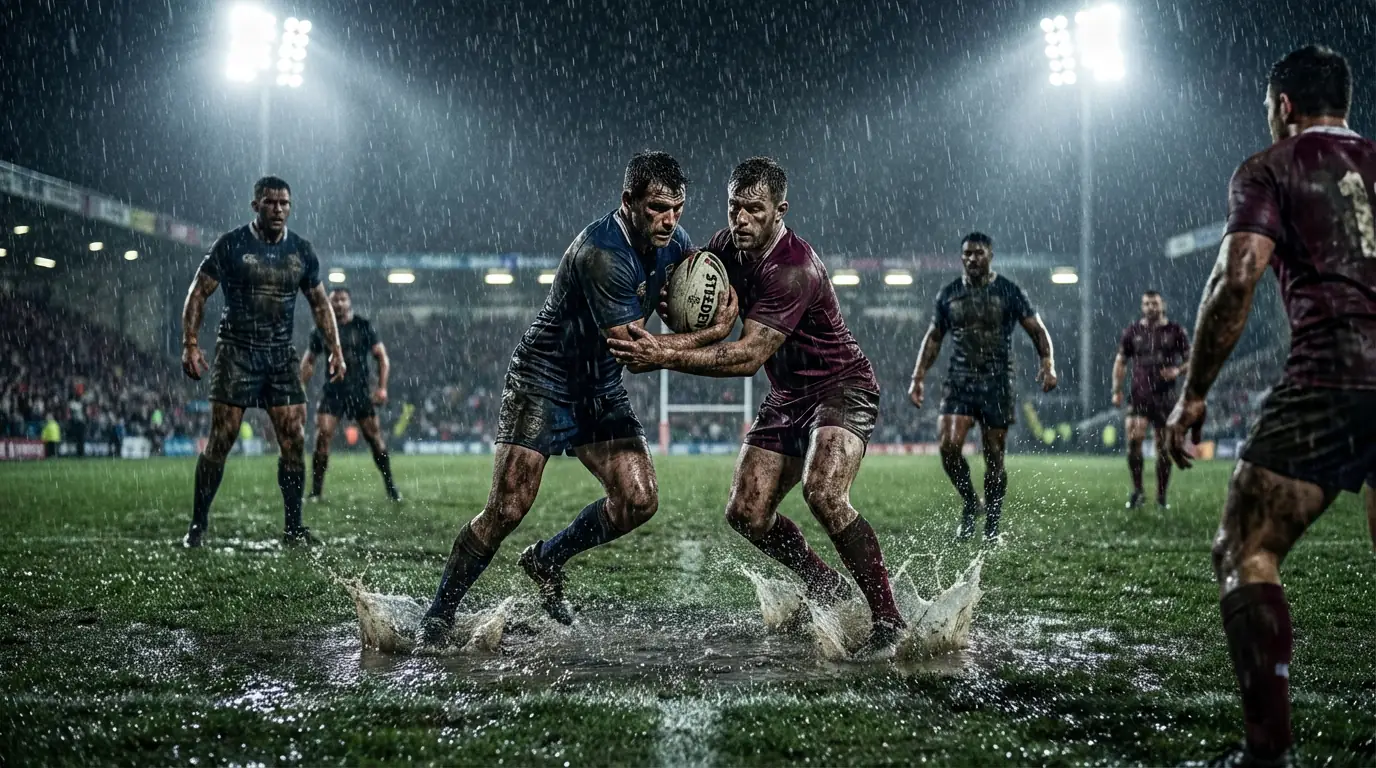
Rain is the single biggest external factor in totals betting. A wet ball increases handling errors, reduces offloading, and forces kicking games. NRL matches played in persistent rain average noticeably fewer points than those played in dry conditions. If you see rain forecast on game day and the total points line has not adjusted downward, the under becomes attractive.
Wind matters too, though its effect is subtler. Strong crosswinds make goal-kicking unreliable, meaning converted tries become unconverted ones. Since the difference between a try and a converted try is two points, and a typical match involves six to eight tries, wind alone can shift the total by eight to twelve points across a full game. Bookmakers factor in weather to some extent, but lines are often set early in the week, well before precise game-day forecasts are available.
Venue dimensions and surface quality add further nuance. Matches played on smaller, narrower grounds tend to produce fewer line breaks because there is less space for attacking players to exploit. Games at large rectangular venues with firm, fast surfaces see more open play and higher scoring. It sounds granular, but bettors who compile venue-specific scoring averages and overlay them with weather data develop a meaningful informational advantage over time.
Points Lines vs Tries Lines: Choosing Your Market
Most punters default to total points because it is the more prominent market, but total tries lines deserve serious consideration. The key distinction is that tries lines strip out goal-kicking variance. Two teams might produce the same number of tries, but vastly different point totals depending on whether the kickers are having a good or bad night. If your analysis points to a high-try-count game but one team’s goalkicker has been unreliable, the tries over may offer better value than the points over.
There is also a structural quirk worth noting. Because tries are discrete events (whole numbers), the over/under lines for tries tend to cluster around 7.5 and 8.5 in NRL. This means the market is less granular than points totals, where lines shift in increments of 0.5 across a wider range. The narrower set of possible lines for tries means that small edges in your model translate into proportionally larger expected value.
One more factor to consider is late scoring. When one team has a comfortable lead in the final ten minutes, the trailing side often throws the ball around in desperation, either conceding intercept tries or scoring consolation tries themselves. Both outcomes inflate the total. Matches between a strong favourite and a weak underdog frequently see a flurry of late tries that push the total over, regardless of how the first sixty minutes played out.
Scoring Is a Language, Not a Number
Over/under betting in rugby league is fundamentally about understanding the language of a match before it happens. Every fixture has a story written in its completion rates, missed tackles, kicking games, and weather forecasts. Totals markets let you bet on that story without needing to predict its protagonist. When you learn to read the script rather than guess the ending, the over/under becomes one of the most logical and repeatable markets in rugby league betting. Over/under totals on rugby league betting tips.
